
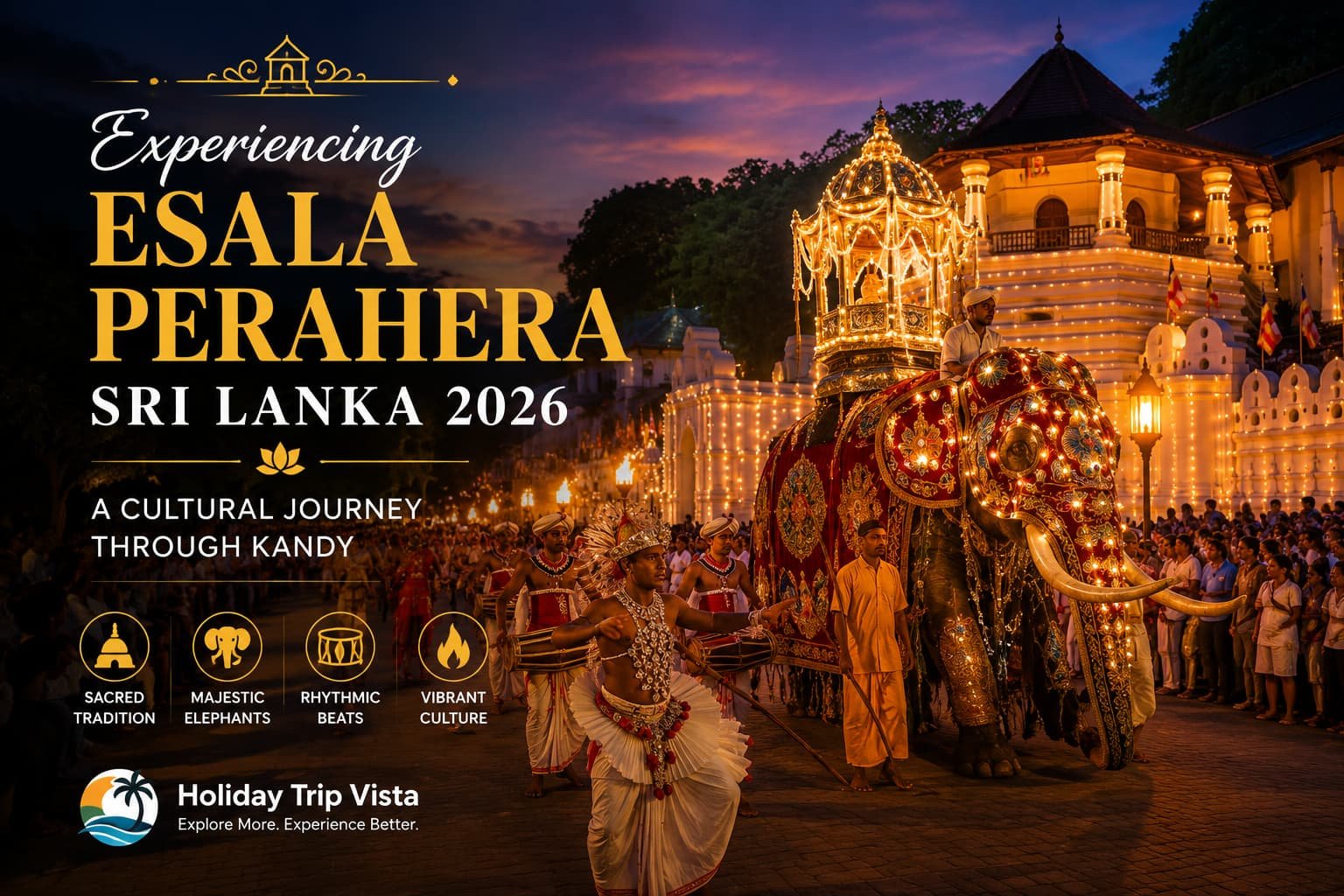
Standing on the crowded streets of Kandy as the sun sets, you feel the air change. The usual evening bustle of the hill city gives way to something deeper. Drums begin to echo in the distance. People lean forward with quiet anticipation. This is Esala Perahera Sri Lanka 2026, and it is unlike anything else you will find in the country.
I arrived in Kandy just as the festival was gathering momentum. The first nights of the Kumbal Perahera had already begun, and the city felt charged with purpose. Locals and visitors from every corner of the island, and beyond, filled the sidewalks along the procession route. Many had come simply to pay respects. Others, like me, wanted to witness one of Asia’s most remarkable living traditions up close.
The Heart of the Festival
Esala Perahera centers on the Temple of the Sacred Tooth Relic, known as Sri Dalada Maligawa. The sacred tooth of the Buddha has been protected here for centuries. Each year during the lunar month of Esala, the temple and the four guardian devales of Natha, Vishnu, Kataragama, and Pattini come together in a grand procession that winds through the streets of Kandy.
What you see is not a performance staged for tourists. It is a religious observance that has evolved over more than two thousand years. Early rituals asked the gods for rain and protection of the land. When the Tooth Relic arrived in Sri Lanka in the fourth century, the ceremony gained even deeper meaning. By the eighteenth century, under the Kandyan kings, the procession took the form we still recognize today. Buddhist and Hindu elements move together in one continuous flow of devotion, music, and pageantry.
In 2026 the festival runs from 18 to 28 August. The first five nights belong to the Kumbal Perahera. These processions feel more intimate. Fewer elephants walk the route. The crowds are lighter. You can stand closer and notice the details of the costumes and the steady rhythm of the drums. Then the Randoli Perahera begins. The scale grows night by night until the Grand Randoli on 27 August. On the final day, a daytime procession and the traditional water-cutting ceremony at the Mahaweli River bring the festival to a close.
What You Actually See and Hear
As the procession approaches, the first sound you notice is the sharp crack of whips. The whip-crackers clear the path and announce that the sacred journey has begun. Behind them come torchbearers and fire dancers. Flames spin through the air, lighting the faces of the crowd. Flag bearers follow, carrying colorful standards that represent temples, regions, and ancient kingdoms.
Then the dancers appear. Kandyan dancers in elaborate headdresses and silver ornaments move with precision and power. Different troupes perform their own styles, each with its own history and symbolism. The drummers never stop. The deep beat of the davul and the sharper tones of the geta bera create a rhythm you feel in your chest. It is impossible to stand still once the music surrounds you.
The elephants form the visual heart of the night. Dozens of them, sometimes nearly a hundred on the grandest evenings, walk in measured steps. Their bodies are covered in richly embroidered cloths and strings of lights. The most important elephant, the Maligawa Tusker, carries a golden casket that represents the Sacred Tooth Relic. A canopy is held above the casket by attendants. When this elephant passes, many people press their palms together and softly chant “Sadhu.” The moment feels solemn and deeply moving.
Behind the lead tusker walks the Diyawadana Nilame, the chief lay custodian of the temple, dressed in traditional Kandyan attire. Officials from each of the four devales follow with their own elephants, dancers, and musicians. The entire procession can stretch more than a kilometer. It takes several hours to pass any single point along the route.
Practical Tips for Visitors
Arrive early if you want a good viewing spot. Many people claim places along Dalada Veediya and the surrounding streets by late afternoon. The atmosphere builds slowly as the light fades and more spectators gather. Be prepared for large crowds, especially on the later Randoli nights. Keep valuables secure and stay patient. The procession moves at a steady pace, and the experience rewards those who remain present rather than rushing for photographs.
Respect remains essential. This is a living religious festival. Dress modestly, keep your voice low when the sacred casket approaches, and avoid blocking the path of participants. Many Sri Lankans attend primarily to pay homage. Visitors are welcome, yet the most meaningful moments come when you observe rather than treat the event as pure entertainment.
Kandy itself becomes a wonderful base during these days. The lake reflects the temple lights at night. Small cafes and restaurants stay open late. You can combine the Perahera with visits to the Temple of the Tooth during the day, or explore the surrounding hills and botanical gardens when the processions are not underway.
Why This Festival Stays With You
What surprised me most was the emotional weight of the experience. The first night I watched, I focused on the spectacle: the lights, the costumes, the sheer number of people moving as one. By the third night I found myself quieter. The steady drums, the careful steps of the elephants, and the devotion visible on so many faces created a sense of continuity that is rare in modern travel.
Esala Perahera Sri Lanka 2026 is not just a calendar event. It is a living link to the island’s spiritual and cultural past. You leave with more than photographs. You leave with the memory of a city that still gathers each year to honor something greater than itself.
If you are planning tour in Sri Lanka, arranging your visit around these August nights offers one of the most memorable cultural experiences the country can provide. The streets of Kandy fill with light, sound, and shared purpose. Stand among the crowd, listen to the drums, and watch the procession pass. You will understand why this tradition has endured for so long.